


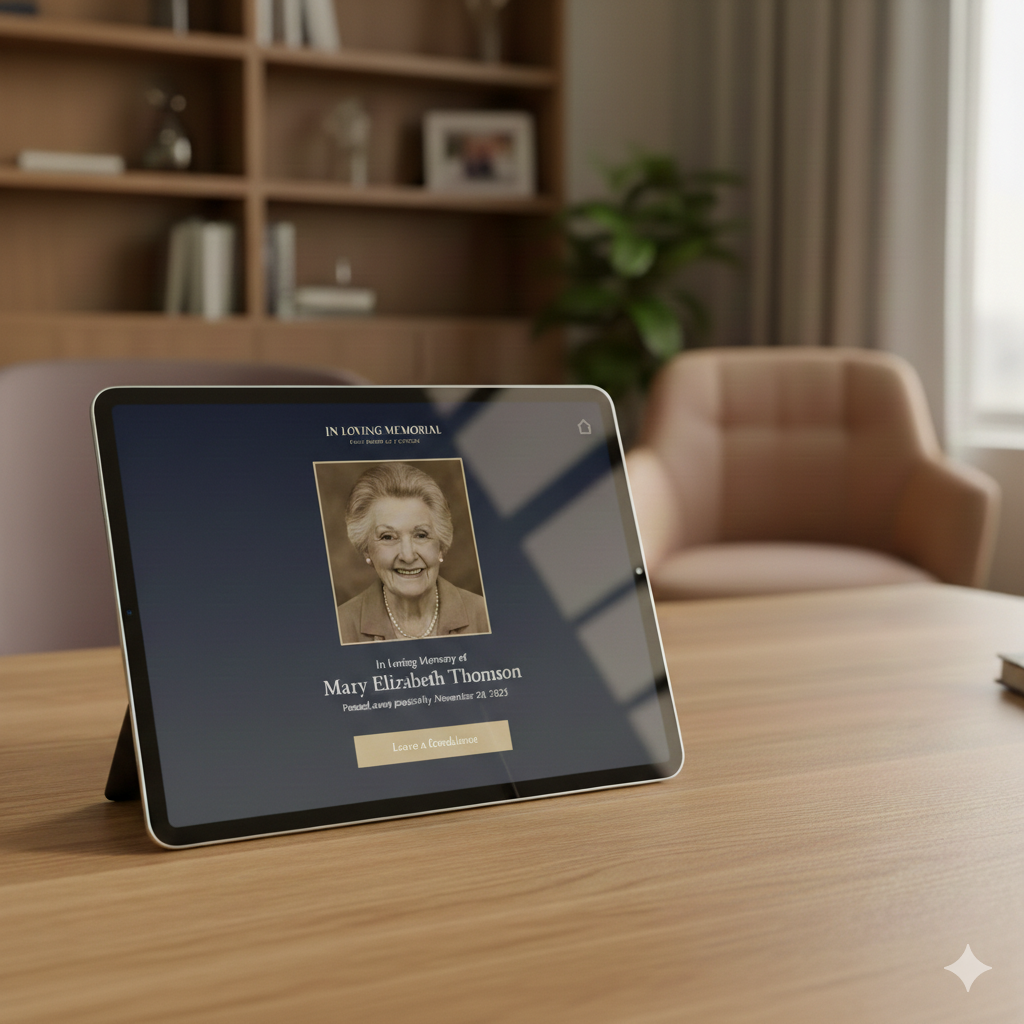
1. The Rise of Digital Obituaries
With 568,613 deaths registered in England and Wales in 2024 alone (ONS, Death Registration Summary Statistics 2024), the volume of obituaries published each year is enormous. Increasingly, those notices are going online rather than into print.
Funeral-notices.co.uk, one of the UK's largest third-party platforms, now hosts over 5 million funeral notices and receives more than 3 million visits every month (Reach Solutions). Funeral Guide, meanwhile, has grown to become the UK's most-visited funeral website, with free obituaries and donation tools that have helped raise nearly £2 million for charitable causes through its platform (Funeral Guide).
These numbers illustrate a fundamental shift: families are moving online. The pandemic accelerated this - capacity limitations reduced foot traffic to funeral chapels while simultaneously driving more families to access obituaries, post condolences, and join livestreamed services online. But the trend was already well underway, and it isn't reversing.
As the National Society of Allied and Independent Funeral Directors (SAIF) put it, the funeral profession has undergone "unprecedented change." SAIF chief executive Terry Tennens urged members to "embrace the digital revolution," noting that "bereaved families expect to be able to view a funeral director's services and prices on a tablet or laptop in the comfort of their home" (Funeral Guide / SAIF).
Why Families Prefer Online Obituaries
- Instant sharing: With WhatsApp now used by 90% of UK adults (Ofcom, Online Nation 2025), families can share service details instantly via messaging, Facebook, and email. Paper notices can't be forwarded.
- Extended reach: Friends and relatives who live far away - or simply can't attend - can participate in the memorial without travelling.
- Ongoing tribute: Unlike a newspaper notice that disappears after a day, an online obituary becomes a permanent gathering point for condolences and memories.
- Interactive features: Condolence messages, photo uploads, and memory sharing create engagement that print simply cannot match.
The Numbers You Need to Know
In a recent conversation with a funeral director, he mentioned that 75% of his website traffic came from obituary pages. Industry data suggests this isn't unusual - obituary pages typically receive 3-5x more visits than any other page on a funeral home website.
Research shows that obituary page visitors are predominantly:
- Women aged 50+ (consistent with the demographic data from SimilarWeb analysis of funeral-notices.co.uk, where the largest visitor age group is 65+)
- Living locally
- Often connected to multiple people who may need funeral services in coming years
In other words: these visitors are future families. Every obituary page view is a soft introduction to your services - delivered at a moment when the visitor is emotionally receptive and thinking about mortality.
With the average UK funeral now costing £4,285 - an all-time high, up 3.5% year-on-year (SunLife, Cost of Dying Report 2025) - families are doing more research online than ever before. Only 35% of people shop around between funeral directors (SunLife, 2025), which means the first impression your website makes is often the only one that matters.
The Practical Challenges
- Administration. Someone has to upload the photo and text for each obituary. This takes time.
- Technical queries. If a family member can't leave a message or encounters an error, they may call you for support.
- Initial setup. Building or integrating an obituary system requires either technical capability or a website provider that includes it.
- Ongoing maintenance. Systems need updates, security patches, and occasional troubleshooting.
These challenges are real - but manageable. And the trade-off of giving away 75% of your website traffic is rarely worth the convenience.
2. Your Actual Options
When it comes to online obituaries, UK funeral directors essentially have three paths. Each involves trade-offs between control, effort, and cost.
Option A: Third-Party Platforms
Services like funeral-notices.co.uk (owned by Reach plc), Funeral Guide, and Muchloved partner with funeral directors across the UK, offering donations, photo and video tributes, and social media sharing.
How it works: You provide obituary details to the platform. They host the tribute page on their domain (or embed it on yours) for a subscription fee or as part of a partnership arrangement. Families visit their site to view the obituary, leave condolences, and make donations.
Pros:
- Minimal technical effort - the platform handles everything
- Established systems with proven reliability
- Built-in donation processing (funeral-notices.co.uk alone has helped raise millions for charities via their JustGiving integration)
Cons:
- Traffic typically goes to their domain, not yours
- Search engines index their site, not yours
- Families experience their branding, not yours
- You lose the ongoing relationship touchpoint
- Contact data and engagement patterns belong to them
When a family member searches for "John Smith funeral" or "Margaret Davies obituary," they may land on a third-party website - not yours. You're doing the work. They're building the audience.
To put this in perspective: funeral-notices.co.uk has amassed over 5 million notices (funeral-notices.co.uk). That's 5 million pages of content (and traffic) built on the back of funeral directors' work.
Option B: Build Your Own
Some funeral directors with in-house technical capability (or a web developer on retainer) build custom obituary systems directly into their websites.
How it works: A developer creates obituary templates, a content management interface for uploading notices, and interactive features like comments and donation links. Everything lives on your website.
Pros:
- Maximum control over design, features, and branding
- All traffic stays on your site
- Full ownership of data and family relationships
- Can be customised to your exact workflow
Cons:
- Significant upfront development cost
- Requires ongoing maintenance and updates
- Security vulnerabilities if not properly maintained
- Technical problems become your problem to solve
- Need someone with technical skills to manage it
This option is best for larger firms with dedicated IT resources or a reliable developer relationship. For most independents, it's more complexity than it's worth.
Option C: Integrated Website Provider
A growing number of funeral-specific website providers include obituary functionality as a core feature. The provider handles the technical infrastructure, but the obituaries live on your domain.
How it works: You get a website purpose-built for funeral directors, with obituary pages integrated into your site. You upload obituary details through a simple interface. The provider handles hosting, security, and technical maintenance.
Pros:
- Obituaries live on your domain - you keep the traffic and SEO benefit
- No technical maintenance required on your end
- Purpose-built for funeral director workflows
- Often includes related features: online payments, pre-need enquiries, Google reviews
- Professional design without custom development costs
Cons:
- Monthly subscription cost
- Less customisation than a fully bespoke build
- Dependent on the provider's continued service
- Still requires someone to upload each obituary
For most independent funeral directors, this represents the best balance: you get the traffic and SEO benefit of hosting obituaries yourself, without the technical burden of building and maintaining the system.
3. Making Obituary Pages Work Harder
A static obituary page - name, dates, and service details - does the minimum. It announces. But it doesn't engage. Here's what separates a basic obituary from one that builds lasting relationships.
Invite Return Visits
Let families leave condolence messages. Let them upload photos and share memories. Each new contribution creates a reason for others to come back and see what's been added.
One funeral director described this as turning a single visit into five. The notice goes up. Friends visit. Someone adds a memory. Others return to read it. A photo appears. People come back again.
Capture Anniversaries
Death anniversaries, birthdays, and holidays are moments when grief resurfaces. A page that families can return to - where their tribute still lives, where they can add a new message - keeps your funeral home present at these moments.
Families consistently respond to anniversary outreach with comments like "You're the only one who remembered" and "That meant more to me than you know."
If the tribute page lives on your site, you can send a gentle reminder: "Thinking of Margaret today - her tribute page is always here if you'd like to visit." If it lives on a third-party platform, that touchpoint belongs to someone else.
Support Easy Sharing
Families want to share service details with extended networks. With 90% of UK adults now using WhatsApp and 85% using Facebook (Ofcom, Online Nation 2025), these are the primary channels for funeral announcements - not newspaper notices or PDF attachments.
A well-designed online tribute page is instantly shareable. And every share introduces your funeral home to someone new.
The Aftercare Connection
Obituary pages and aftercare programmes are two sides of the same coin. Both aim to maintain relationships after the service ends. Both create reasons for families to stay connected.
The best funeral aftercare follows a predictable rhythm:
- 1-2 weeks post-service: Compassionate check-in to ensure families are adjusting
- 4-6 weeks: Share grief resources as families re-enter daily life and the initial support network fades
- 6-8 weeks: Request feedback or reviews, once families can better reflect on their experience
- Ongoing: Birthday and anniversary remembrances - these often arrive months after the service, when outside support has typically faded
- November-December: Holiday outreach during the difficult first season without their loved one
- 3-6 months: Introduce pre-need planning conversations as life begins to settle (pre-paid funeral plans are growing in popularity, with 40% of those who make provision now choosing them according to SunLife, 2025)
An obituary page hosted on your own site becomes the anchor for all of this. The tribute page is where the family returns. The aftercare programme is what reminds them to do so.
Without your own obituary system, you're asking families to remember you - without giving them a place to come back to.
4. Implementation Without the Headache
If you've read this far and thought "this sounds like a lot of work," you're not wrong. Building an obituary system from scratch is a significant undertaking. But you don't have to build from scratch.
A Realistic Assessment
If you have moderate resources: An integrated website provider is likely your best path. You get obituaries on your domain without the technical burden. The subscription cost is typically offset by not needing a separate web developer.
If you have strong technical capabilities or financial resources: Building your own system gives you maximum control. But be realistic about ongoing maintenance - the initial build is just the beginning.
The Minimum Viable Obituary Page
Whatever approach you choose, ensure your obituary pages include:
- Clear display of name, dates, and service details
- A photo of the deceased
- Condolence messaging (even if just a simple form)
- Social sharing buttons (WhatsApp, Facebook, email - the channels UK families actually use)
- Mobile-responsive design (96% of UK adults are mobile phone users, and 77% of those aged 65+ now own a smartphone (Uswitch / Statista, 2024) - your visitors will be on their phones)
- Your funeral home branding and contact information
The Bottom Line
Every obituary you host on a third-party platform is traffic you're giving away. Every search for a deceased person's name that lands on someone else's domain is a future family introduction you've lost.
The UK funeral services market is projected to grow from $2.75 billion in 2023 to $4.44 billion by 2035 (Allied Market Research), driven in part by digital transformation. The shift to digital obituaries isn't slowing down. The question is whether you'll capture that value - or continue donating it to platforms that don't share your long-term commitment to serving families.
Obituaries aren't just a service. They're a relationship-building engine. Treat them accordingly.
Derrick Grant Founder, FuneralBranch.com
📞 0121 838 9308 ✉️ derrick@funeralbranch.com 🔗 linkedin.com/in/derrick-grant-8631699
If you'd like to see how other funeral directors are handling online obituaries - real examples, not theory - just get in touch. I'm happy to share what's working.
Sources Referenced
- ONS - Death Registration Summary Statistics, England and Wales: 2024
- Reach Solutions - Funeral Notices (funeral-notices.co.uk traffic and scale)
- Funeral Guide - Growth and obituary platform data
- SAIF - Digital revolution in funerals (Terry Tennens, Chief Executive)
- SunLife - Cost of Dying Report 2025
- Ofcom - Online Nation Report 2025
- SimilarWeb - funeral-notices.co.uk audience demographics
- Uswitch / Statista - UK Mobile Phone Statistics 2024
- Allied Market Research - UK Funeral Services Market Report


